Most transformation programs don't fail at launch. They fail quietly, three status reports later.
Independent assurance that tells leadership what's actually confirmed, what's assumed, and what's still genuinely unknown — while there's still time to act on it cheaply.

A green status report and a healthy program are not the same claim.
Large transformation programs generate their own optimism. A status report written by the team delivering the program tends to describe progress in the most favorable honest light available — which is a genuinely different thing from an independent, evidence-graded view of what's actually confirmed, what's estimated, what's assumed, and what's still completely unknown. By the time a program's real state becomes visible to leadership through the usual channels, the window to correct course cheaply has often already closed.
This isn't dishonesty. It's structural. The people closest to a program are also the ones most invested in its success, which makes them, almost by definition, the last people positioned to see it clearly and say so plainly. An independent function whose only job is to look — not to deliver, not to defend a plan it authored — sees the gaps that get quietly smoothed over three layers before they reach a board slide.
Transformation Assurance exists to give leadership that independent, confidence-graded read at regular intervals — not a duplicate status report, and not a post-mortem written after a program has already stalled. Every material claim behind a program's status gets rated on the strength of its evidence, not the confidence of the person making it, and reviewed on a cadence tied to real milestones rather than to how comfortable the last update felt.
Why this isn't an audit
A traditional audit arrives once, usually after something has already gone visibly wrong, and produces a long list of findings that gets filed and rarely revisited. For a board or CEO, that means the first independent read of a struggling program often arrives too late to be useful. For a supply chain leader whose plans depend on a program's promised go-live date, it means finding out about slippage only once it's unavoidable.
| Generic program audit | Transformation Assurance | |
|---|---|---|
| Timing | Once, usually after something's gone wrong | On a defined cadence, before something goes wrong |
| Findings | A long list of issues, unranked | Confidence-graded claims — confirmed, estimate, assumption, unknown |
| Relationship to the team | Adversarial and retrospective | Independent, but collaborative and forward-looking |
| Output | A report filed and rarely revisited | A live view leadership actually checks between milestones |
| Whose interest it serves | Compliance | The decisions leadership is about to make |
What this looks like at every level of your organization
A program's real state looks different depending on where you sit inside it — and an assurance function that only speaks to the board misses the layer where most of the honest signal actually lives.
"I flag a real risk in a working session, and by the time it reaches the steering committee slide, it's been rounded up to 'on track, minor risk.'"
What changesAssurance interviews the team directly and reports confidence levels grounded in that conversation — not a summary that's been filtered through several layers of institutional optimism on the way up.
"The program timeline assumes my plant is ready for a cutover I haven't actually seen tested yet."
What changesReadiness claims get validated directly against site-level evidence, not against the project plan's optimism — so a site lead isn't the one left holding an untested assumption on go-live day.
"I'm the one presenting status upward, and honestly, I don't always know which of my own team's updates I should be fully trusting."
What changesAn independent, confidence-graded view gives program leadership the same clarity they're expected to give the board — so they're informed alongside leadership, not caught out by it.
"Technical debt keeps getting logged as 'in progress' for two quarters running, and I genuinely can't tell if that's still true or just comfortable to keep writing."
What changesTechnical claims get checked against evidence. A workstream that's "in progress" for two quarters either shows real movement or gets reclassified honestly — no permanent amber status.
"I've approved follow-on funding for a program based on a status report that turned out, in hindsight, to be more hope than fact."
What changesFinancial claims tied to program milestones get the same confidence grading as everything else, so funding decisions rest on evidence rather than a narrative built to sustain momentum.
"I don't want to learn a flagship transformation program is in real trouble from the person who's been running it and reporting it as fine."
What changesA regular, independent review gives the board a genuine early-warning system — one that doesn't depend on the program's own leadership choosing to volunteer bad news.
Six habits behind assurance that leadership actually trusts
Confidence grading beats a simple status color
Confirmed, estimate, assumption, unknown — four honest categories tell leadership more than one comforting shade of green.
Independent means independent, not adjacent
The assurance function reports to leadership, not to the program it's reviewing — by design, not as a courtesy.
Forward-looking, not only retrospective
We ask what could still go wrong from here, not only what already went wrong — the more useful question, and the harder one. A risk that's just beginning to surface gets flagged honestly as emerging, before it hardens into an issue nobody saw coming.
Evidence over narrative, every time
A claim without supporting evidence gets classified as an assumption, however senior or confident the person making it.
Cadence beats a single audit
Reviewed on a defined schedule tied to real milestones — not commissioned only once trust has already visibly broken down.
The goal is zero surprises, not zero problems
Problems found early and named honestly are the sign of a healthy program under review — not evidence of a failing one.
The Confidence Ladder
Every material claim behind a program's status gets placed on the same four-rung ladder — and moves up only when the evidence earns it.
Most status reports collapse this into one color. We keep the four levels visible, on purpose.
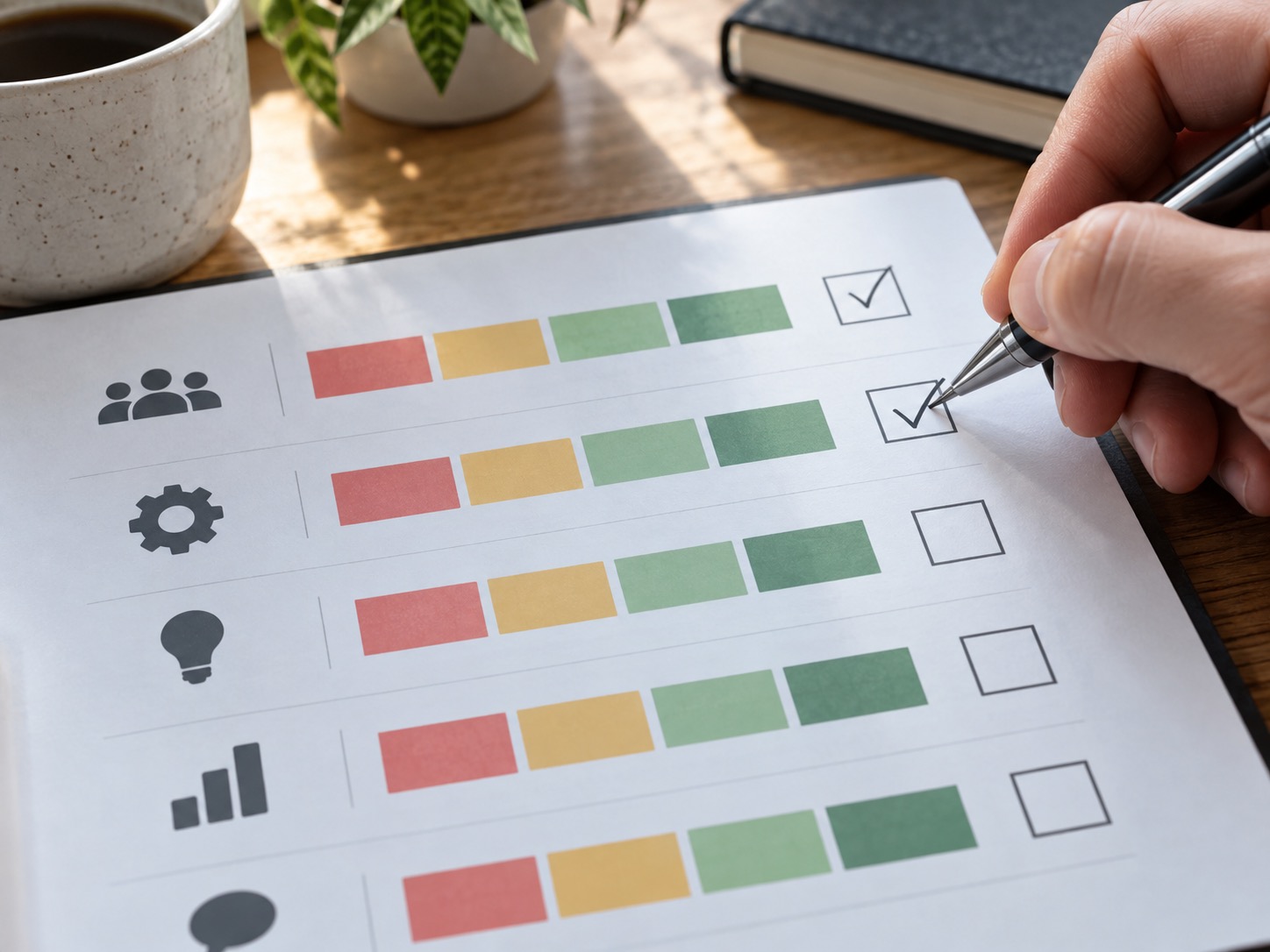
Every claim category gets checked against a different kind of evidence
| Claim type | Typically just reported as | What assurance checks |
|---|---|---|
| Site readiness for cutover | "On track" | Independently verified readiness criteria, not the plan's timeline |
| Integration testing status | "Complete" | Test evidence reviewed directly, not a checklist self-marked done |
| Benefits case still holding | "On track" | Re-validated against current data, not the original baseline alone |
Assurance that earns trust, one honest cycle at a time
Start narrow
Review the two or three claims leadership actually relies on most for its next decision, not the entire program at once.
Grade honestly, in the open
Confidence levels are shared with the program team as well as leadership, so nobody on either side is blindsided by the read.
Repeat on a fixed cadence
Tied to real milestones, not to how comfortable the previous review happened to feel — consistency is what makes the read trustworthy.
Cross-workstream dependencies get a named owner, not just a spreadsheet
Confidence grading tells leadership how solid a claim is. On its own, it doesn't say what breaks elsewhere in the program if that claim turns out wrong. For programs with several workstreams moving in parallel, we make dependencies actionable — critical-path analysis, an explicit link back to the decision or assumption each one depends on, and a review routine that keeps timing and impact visible between steering meetings, not just at them.
Independent review is most valuable in the middle of a program, not just at the start or the end
Most programs get outside scrutiny at two moments — the business case at kickoff, and a post-mortem after things have already gone visibly wrong. The highest-value window sits in between, while a course correction is still cheap and a claim can still be checked before it hardens into a commitment nobody wants to walk back.

Ready for an honest read on a program already underway?
Let's confidence-grade the two or three claims your next milestone actually depends on, and see what the evidence really supports.