Training only builds capability if it changes what someone does differently on Monday.
Workshops, executive briefings, knowledge-transfer sessions, and structured capability-building programmes across management, operations, technology, AI, data, analytics, software, and project leadership — calibrated to the room, tied to a capability gap that's actually been named.
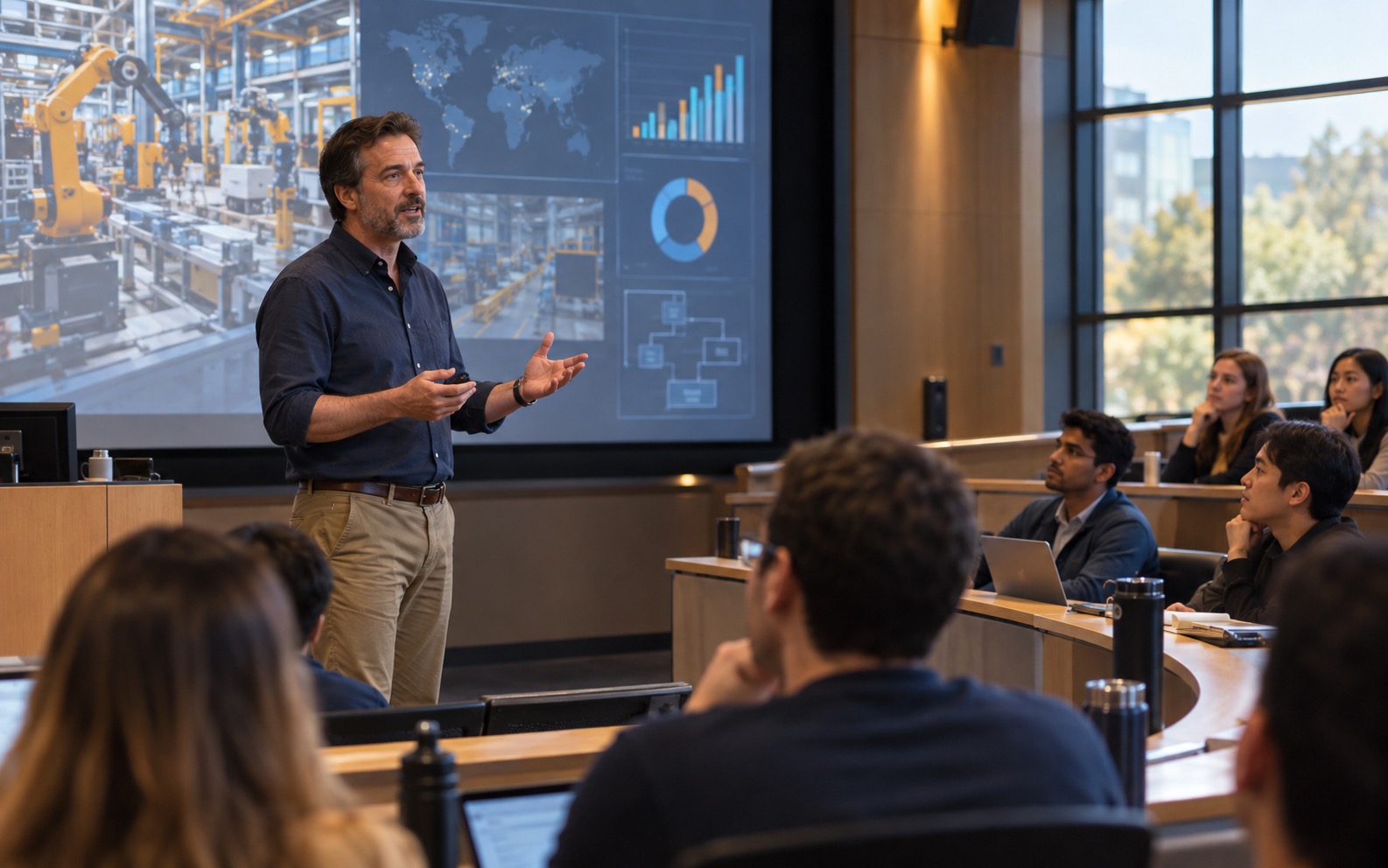
Most training happens because a budget line exists, not because a capability gap has been named
Most corporate training gets commissioned the same way: an L&D calendar needs filling, a course catalogue gets browsed, and a session gets booked because the topic sounds relevant. Attendance gets recorded, a feedback form gets collected, and everyone moves on — with very little visibility into whether anyone's actual judgment changed, or whether the underlying capability gap that (in theory) justified the spend was ever precisely named in the first place.
The instinct to reach for a generic course is understandable — building content from scratch, calibrated to one organization's real operating and technology context, takes more effort than picking something off a shelf. But generic content is exactly what gets forgotten by the following week. Real capability transfer requires starting from a specific gap — a team that can't yet operate a new system confidently, a leadership group that needs a shared vocabulary for AI or data investment decisions, a project team that needs a common delivery discipline — and building the session around closing that gap specifically.
Training & Capability Building exists to make that starting point deliberate. Every engagement — whether a single executive briefing, a hands-on workshop, a knowledge-transfer session, or a structured multi-session programme — is built around a named capability gap in management, operations, technology, artificial intelligence, data, analytics, software, or project and programme management, calibrated to the audience's actual depth, and measured by whether it changed what people do differently afterward, not by whether the room enjoyed it.
Why this isn't generic corporate training
Most training vendors start from a course catalogue and fit your organization into whichever module is closest. For a board or CFO approving a capability-building budget, that shows up later as a training spend nobody can connect to a changed outcome. For an operations or project leader, it shows up sooner — as a well-reviewed session that changes nothing about how the team actually decides and acts the following week.
| Generic corporate training | Training & Capability Building | |
|---|---|---|
| Starting point | A course catalogue, fitted to your organization | A named capability gap, tied to a real decision |
| Content | Repackaged theory or public case studies | Real operating and technology situations, made teachable without exposing confidential detail |
| Depth | One fixed level for the whole room | Calibrated to the audience — shop floor through boardroom |
| Format | A standard course, delivered as-is | Workshop, executive briefing, knowledge-transfer session, or a structured programme |
| Success measured by | Attendance and feedback scores | Whether judgment on the job actually changes |
What a capability gap looks like at every level of your organization
A capability gap rarely announces itself the same way twice. It shows up as a different, entirely genuine frustration depending on where you sit — and a training session that only speaks to one of those levels leaves the others exactly where they started.
"I was trained on the new system for two hours in a classroom, and none of it matched what I actually had to do on my first real shift with it."
What changesSessions are built around the real workflow the operator will actually use, not a generic system overview — calibrated to shop-floor depth, not adapted down from a slide deck built for someone else.
"I'm expected to start using data and AI tools in my daily work, and the one training session I got barely scratched the surface of how they actually apply to what I do."
What changesKnowledge-transfer sessions go deep on the specific domain — data, analytics, or AI — as it applies to the engineer's actual function, not a company-wide overview built for the lowest common denominator.
"I need my team confident operating the new system, not just aware that a training session happened."
What changesEvery session is measured against a specific capability outcome named upfront, and revisited afterward — not against attendance or a feedback survey.
"My team comes out of project-management training with certificates, but still can't speak a common vocabulary in a steering meeting."
What changesProgramme and delivery-leadership sessions are built around your organization's actual governance and delivery discipline, so the vocabulary a team leaves with is one it will genuinely use.
"Every 'AI awareness' session I commission leaves people curious, but no more capable of actually evaluating a use case afterward."
What changesAI, data, and analytics sessions are built to transfer judgment, not just awareness — calibrated so a participant leaves able to evaluate a use case, not just describe what AI is.
"I approve a training budget every year, and I have no real way to tell whether it built capability or just filled a calendar."
What changesEvery engagement starts with a named capability gap and a defined outcome, so a training spend can be traced to something that actually changed — not just a completion record.
Six habits behind every engagement
Start from a named capability gap, not a catalogue
Before a session gets designed, we name the specific gap it's meant to close and how you'll know it closed — not a topic pulled from a menu because it sounded relevant.
Confidential, but never generic
Real operating and technology situations, reshaped into anonymized composite scenarios and role-based perspectives — the specificity of genuine experience, without naming or exposing a single client detail.
Depth calibrated to the room
Shop floor through boardroom — the same underlying discipline, delivered at the altitude that actually lands for that specific audience.
Format follows the goal, not a template
Workshop, executive briefing, knowledge-transfer session, or a structured multi-session programme — chosen for what the capability gap actually needs.
Built to transfer, not just to inform
The measure of a good session isn't whether the room found it interesting. It's whether a participant does something differently in their next real decision.
Success measured by changed judgment, not attendance
Completion records and feedback scores are a hype signal, not a capability signal. We define the outcome upfront, and check whether it actually happened.
From Capability Gap to Capability Built
The same six-step discipline runs through every engagement, whether it's a single executive briefing or a structured multi-session programme.
A single executive briefing moves through this quickly. A structured capability-building programme lingers on each step — the discipline is the same either way.

Capability domains, matched to the format that actually fits
| Capability domain | Typical format fit |
|---|---|
| Management & operations | Workshop or executive briefing |
| Technology (MES, APS, ERP, digital transformation) | Knowledge-transfer session or workshop |
| Artificial intelligence, data & analytics | Executive briefing or hands-on workshop |
| Software & industrial tools | Knowledge-transfer session |
| Project & programme management | Structured capability-building programme |
Real specificity, without a single exposed detail
The easy way to protect a client relationship is to stay abstract — and abstraction is exactly what makes most training forgettable. Every session here is built from real operating and technology decisions, reshaped into anonymized composite scenarios and role-based perspectives before they ever reach a slide. Participants get the texture of a genuine decision; no organization, plant, or client is ever named or identifiable.

Have a capability gap you can already name?
Tell us the gap and the outcome you're after — we'll help shape the format, depth, and content before a single session gets designed.