Software that solves one problem well beats a platform that solves none.
We build small, purpose-built tools where a large platform doesn't fit — configured before customized, staged through tested go/no-go gates before a single hour of "real" build begins.
The best tool is often the smallest one that actually gets used.
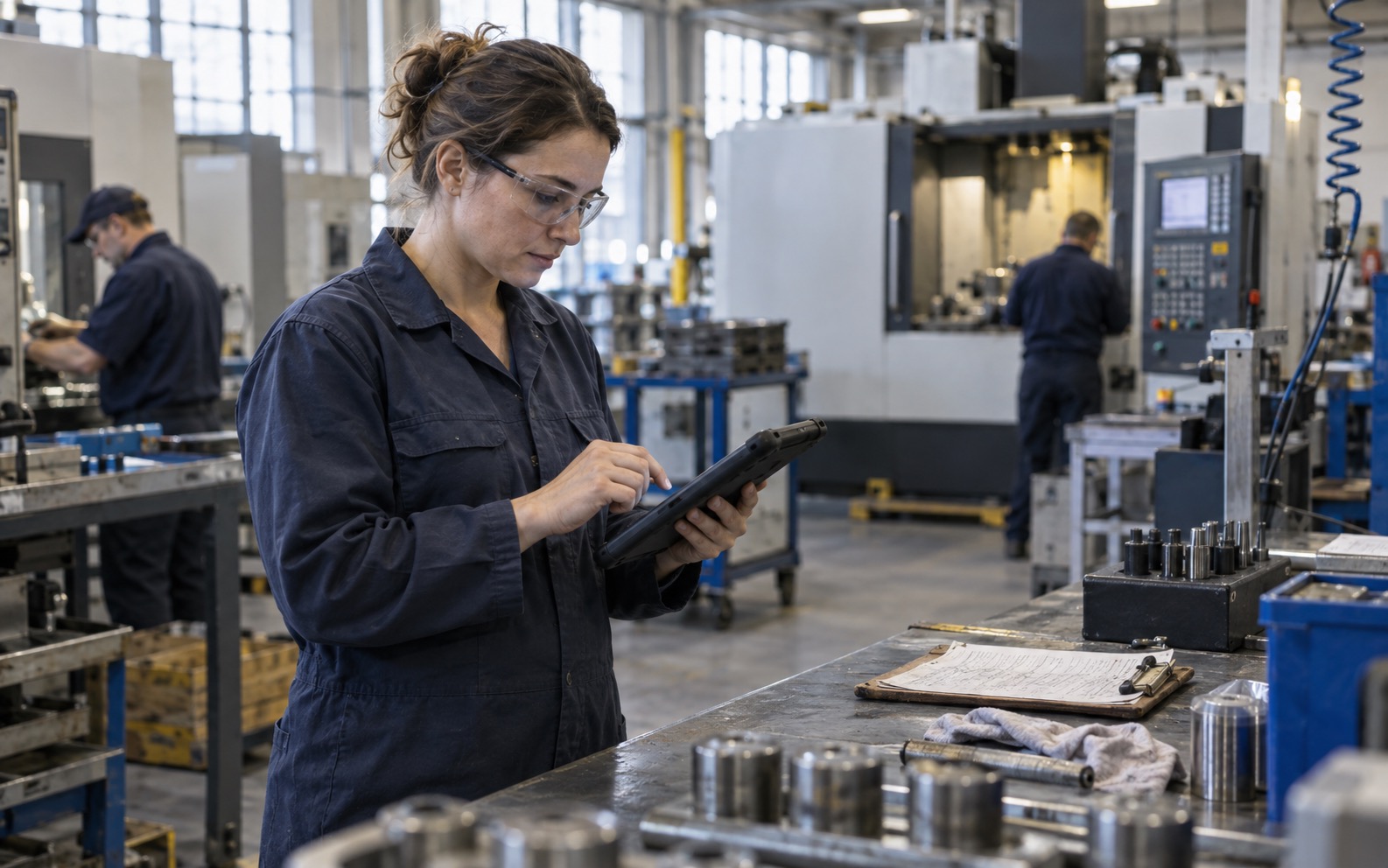
Manufacturing plants are routinely sold platforms sized for problems they don't actually have. Meanwhile, the real gap on the floor is usually something narrow and specific — a changeover checklist that lives on paper, a defect-tagging step that eats fifteen minutes nobody has, an exception that gets routed by memory instead of by rule. A large platform handles that kind of problem poorly, if it addresses it at all, because it was never designed around that one workflow.
The opposite failure is just as common. "Let's just build it ourselves" projects can spiral quietly, because nobody defined what "done" looks like or when to stop calling something a prototype. A tool built in a sprint of enthusiasm becomes the accidental first version of a production system nobody stress-tested, with no owner named for the day the person who built it moves on. Both failure modes come from skipping the same honest question: does this specific problem need a platform, a configuration, or a small piece of purpose-built software — and who owns it once it exists?
Focused Software & Industrial Tools exists to make that decision deliberately, tool by tool, instead of by default. Every tool moves through the same staged gates — prototype, proof of value, pilot, production — each one designed to kill a bad idea cheaply rather than let it accumulate momentum. Nothing reaches "production" without a named internal owner, a documented decision to keep it, and evidence from real operating conditions that it's actually faster than what it replaced. Where AI genuinely helps — summarizing information, flagging exceptions, recommending an action, or orchestrating a small workflow — it's introduced in proportion to the decision's consequence, never as the headline feature of a tool built to solve something narrower.
Why this isn't a platform pitch
Most software vendors and platform consultancies start from what they sell, not from what your floor actually needs — because their business model depends on a build recommendation. For a board or CEO, that shows up later as a platform with a growing licensing bill and a shrinking list of people who still open it. For a supply chain leader, it shows up sooner — as a tool the vendor called "done" that nobody on the floor was ever consulted about building.
| Generic platform pitch | Focused Software & Industrial Tools | |
|---|---|---|
| Starting point | The platform's existing feature list | The one workflow that's actually broken |
| Build decision | Build — because that's the business model | Build, configure, extend, or buy — decided per tool, honestly |
| Delivery | Big-bang go-live | Staged gates: prototype, proof of value, pilot, production |
| Ownership at handoff | A support contract | A named internal owner and a documented keep-or-retire decision |
| Success measured by | Seats licensed, modules deployed | Whether the floor still uses it, unprompted, six months on |
What this looks like at every level of your organization
A tool that solves the wrong-sized problem is a different frustration depending on where you sit — a clipboard replacement that's slower than the clipboard, or a licensing line item nobody can defend at renewal.
"I was handed a new app that's supposed to replace my clipboard, and it genuinely takes longer than the clipboard did."
What changesPrototypes are tested with the people who'll actually use them before a single hour goes into a "real" build. If it's slower than what it's replacing, it doesn't pass the gate — full stop.
"We built an internal tool two years ago that nobody actively maintains anymore, and I honestly don't know if I can still trust what it tells me."
What changesEvery tool gets a named internal owner and a documented decision at each gate — keep, retire, or extend — so it never quietly drifts into being unowned and unverified.
"Every vendor demo looks great on a laptop in a conference room and falls apart in week two on my actual floor."
What changesThe pilot stage runs under real operating conditions — real exceptions, real shift patterns — not a sandbox. Nothing is called "production" until it survives that.
"My team is stuck supporting a growing pile of point tools nobody standardized on the way in, and I have no defensible way to say no to the next request."
What changesAn honest build/configure/buy decision, made against clear fit criteria for every tool, gives IT a defensible basis to say yes, no, or not yet — instead of inheriting whatever got built.
"Tools that touch my planning data get built without my team's input until it's too late to flag what's missing."
What changesSupply chain and planning stakeholders are looped in at the proof-of-value stage, not discovered as an afterthought once a tool is already in pilot.
"We've paid for tools that were declared 'built' and never got properly adopted, and I can't tell which of our current backlog is at the same risk."
What changesStaged gates mean capital is committed incrementally, not upfront. A tool that fails proof of value stops there, instead of continuing to consume budget on inertia alone.
Six habits behind tools that are still used six months later
Build, configure, extend, or buy — decided honestly, tool by tool
Not a default answer applied everywhere. A real question, asked and answered on its own merits, for every single tool request.
A prototype is disposable by design
Its job is to prove or kill an idea cheaply — not to quietly become the first version of the production system nobody stress-tested.
Proof of value means numbers, not enthusiasm
A pilot doesn't advance to production because people enjoyed using it. It advances because it measurably moved a number that mattered.
Configuration beats customization, until it doesn't
We push hard on configuring the platform you already own before writing new code — and we're honest with you the moment that stops being the right call. When something genuinely needs building, it's typically a lean Python-based tool or FastAPI service — not a new platform to maintain.
Every tool gets a named owner before go-live
Ownerless tools become exactly the shadow systems the next data-integration project has to untangle years later.
"Still used at six months" is the only metric that matters
Seats licensed or lines of code shipped tell you nothing about whether a tool actually stuck. We measure the thing that actually matters.
Four gates, not one big-bang launch
Every tool earns its way from idea to production the same way — and can stop at any gate if it doesn't clear it.
Capital is committed incrementally, one gate at a time — not upfront, on a single go-live bet.

Configure the platform you own before writing new code
| Signal to configure | Signal to build | |
|---|---|---|
| Coverage | Existing platform already does ~80% of it | No platform you own comes close |
| Scope | Shared workflow across several lines or plants | Unique to one line, one shift, one exception path |
| Change rate | Stable, unlikely to change often | Evolving fast, needs to iterate weekly |
| Cost of being wrong | Low — easy to reconfigure later | High enough to justify dedicated ownership |
The same staged gates keep AI pilots from becoming expensive science projects
Every discipline in this service — prove cheaply, measure honestly, name an owner before go-live — applies with even more force to AI pilots, where enthusiasm is easy to generate and durable value is harder to prove. A staged-gate habit built here transfers directly the moment an AI initiative needs the same discipline.
Have a workflow that's outgrown its spreadsheet?
Let's run the fit test on one tool idea and see honestly whether it needs a platform, a configuration, or something small and purpose-built.